Only fresh tissues are recommended; frozen samples are not suitable for accurate results.
Welcome to the PathoSense Wet Lab training section!
Here you'll find everything needed to master our laboratory assay procedures.
What You'll Find Here:
- Materials List - Complete inventory of required reagents, equipment, and consumables for performing PathoSense assays.
- Wet Lab Learning Path - Step-by-step training modules covering all wet lab steps.
- Sampling guidelines - For proper specimen collection and handling (at the bottom of this page).
Getting Started:
- Review the materials list to ensure your lab has all necessary components
- Complete each module in the learning path in sequential order
- Successfully pass all quizzes to document your proficiency
Please complete the entire Wet Lab Learning Path before scheduling your follow-up meeting.
Materials Wet lab
Complete Material List PathoSense Dx Assay ✅
You can find the complete list of all materials needed for the PathoSense workflow here:
PathoSense Materials 📦
Part of the required materials will be supplied directly by PathoSense. At the start of the implementation, you will receive two separate shipments:
-
One shipment on dry ice, which includes the VMC for your initial validation experiments
-
One cooled shipment with additional materials
You will receive track & trace codes by email once the shipments are on their way.
📦 More details about the shipments can be found [here].
🔁 To reorder a materials package (sufficient for 576 tests), please use [this order form].
Oxford Nanopore Technologies 🧬
Getting Started with ONT
To begin using PathoSense, your lab will need access to Oxford Nanopore Technologies (ONT) materials.
We will notify ONT that your lab is an official PathoSense partner. This allows you to purchase the dedicated PathoSense bundle through their webshop.
If your lab does not yet have an ONT account, please create one via the ONT website. Once your account is set up, ONT support will reach out to link it to PathoSense, enabling access to the required bundle.
If you don’t have a MinION device yet, you can purchase one through a local supplier or directly from ONT. We recommend choosing a starter pack that includes R10 flow cells to ensure compatibility with PathoSense workflows.
Sartorius Filter 🧪
PathoSense has a direct partnership with Sartorius for our partners.
Sartorius has been informed and will contact your lab shortly to facilitate your filter order.
SOP Aliquoting IC 🫗➗
Here you can find the SOP 'Aliquoting IC +HMB'
PathoSense Analysis overview
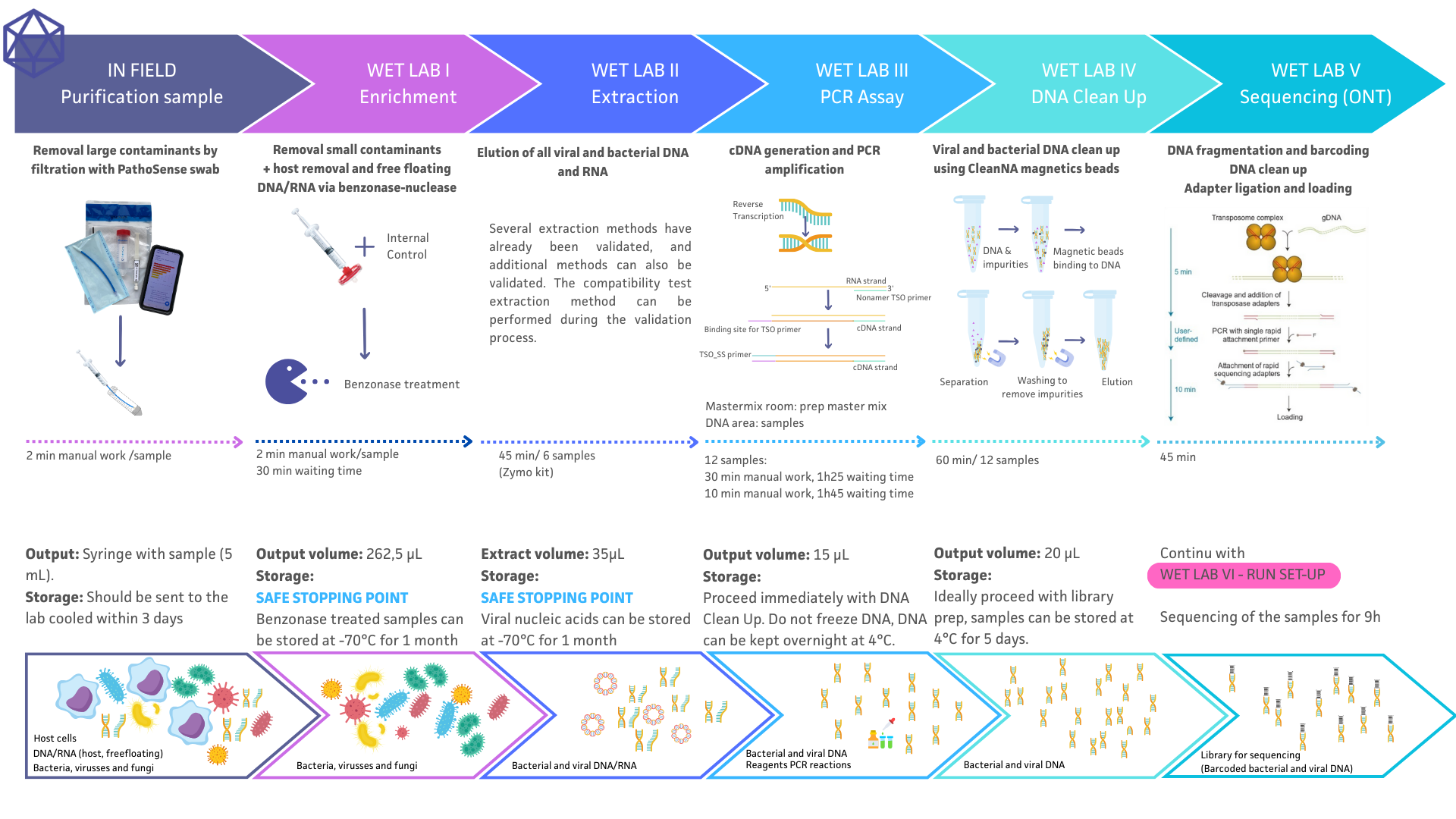
Learning Path Wet lab
There has been a problem with Learn, please contact the administrator of the academy. Error code: 126692f2-e927-4bf7-b621-e4fd56a48320.
There has been a problem with Learn, please contact the administrator of the academy. Error code: 4b82b286-38b2-4212-9cdd-3b024873e7b9.
WET LAB I: Benzonase Treatment
Instructional movie
Filtration and benzonase treatment of the samples to remove free DNA/RNA and host materials
Wet lab 1: Benzonase Treatment
SOP
Filtration and benzonase treatment of the samples to remove free DNA/RNA and host materials.
Wet lab 2: Extraction
Instructional movie
Extraction of RNA and DNA from sample with Zymo kit
Wet lab 2: Extraction
SOP
Extraction of RNA and DNA from sample with Zymo kit
Wet lab 3: PCR Assay
Instructional movie
cDNA generation and PCR amplification.
Wet lab 3: PCR Assay
SOP
cDNA generation and PCR amplification.
Wet lab 4: DNA Clean Up
Instructional movie
Viral and bacterial DNA clean up using CleanNA magnetics beads.
Wet lab 4: DNA Clean Up
SOP
Viral and bacterial DNA clean up using CleanNA magnetics beads.
Wet lab 5: ONT
Instructional movie
Library preparation and loading of the flow cell.
Wet lab 5: ONT
SOP
Library preparation and loading of the flow cell.
WET LAB VI: ONT
Instructional movie
Set-up of a sequencing run on the MinKNOW software and generation of a sequencing run file.
WET LAB VI: ONT
SOP
Set-up of a sequencing run on the MinKNOW software and generation of a sequencing run file.
Sample Preparation & Purification
Samples from veterinarians in the field should be submitted using a Pathosense kit, which is designed to accommodate various types of sample materials.
Certain samples processed in the laboratory require specific preparations. Detailed information regarding these preparations is provided below 👇
PathoSense Sampling kit 💩
In the field, veterinarians use the PathoSense Sampling Kit to collect and purify samples. This ensures that all samples arrive at the lab in a standardized and consistent manner, supporting reliable downstream processing.
📦 Learn more about the Sampling Kit [here]
🧪 Read our blog on collecting high-quality samples [here]
🎬 Watch instructional videos on using the Sampling Kit [here]
Sampling organs 🫁
In the lab, the PathoSense Sampling Kit can be used to swab individual organs directly or to pool organs for a composite sample.
-
For direct organ swabbing, you can watch the instructional video [here].
-
For pooling organs (e.g., spleen, thymus, and heart), combine equal amounts of each organ, cut them into smaller pieces, and then swab the pooled tissue with the PathoSense swab.
An instructional video for this method is available [here].
Serum, Cerebrospinal Fluid and Whole Blood Samples 🩸
Serum and CSF
- Transfer 500 μL into an Eppendorf centrifugal filter (0.8 μm) and centrifuge for 5 minutes at 2000 x g.
- Proceed with 'Wet lab 1: Benzonase'.
Whole Blood
- Centrifuge whole blood (with heparin) for 10 minutes at 2400 rpm (calculate appropriate g-force).
- Transfer 500 μL of plasma into an Eppendorf centrifugal filter (0.8 μm) and centrifuge for 5 minutes at 2000 x g.
Fetus Samples 🐷
For SMEDI-type (brown fetuses & mummies):
See instructional movie ‘ORGAN SAMPLE’
- Collect thymus, heart, and spleen from two brown fetuses & mummies.
- Pool different organs in an equal ratio in a plate and cut them into smaller pieces to expose the interior.
- Use the PathoSense swab to sample the organs by squeezing the swab thoroughly against the organ pieces, ensuring absorption of exudate on the swab.
- Proceed with the standard PathoSense swab purification procedure, by connecting the swab to the syringe and pushing the liquid through the swab in the tube. Mix well and aspirate in the syringe.
- Proceed with 'Wet lab 1: Benzonase'.
For non-SMEDI-type (uniform or heterogeneous fetuses):
Contact PathoSense for further instructions.
Wet Swabs/Lung Lavage 💦
- Vortex the tube containing the swab/lavage for 15 seconds.
- Collect samples in an equal ratio, ensuring a pool of at least 2-4 mL.
- Purify the material using the PathoSense swab.
- If insufficient material is available or unsuitable for the sampler, use 500 μL in an Eppendorf centrifugal filter (0.8 μm) and centrifuge for 5 minutes at 2000 xg.
- Proceed with 'Wet lab 1: Benzonase'.
Dry Swabs 🧽
- Collect samples in a tube, pool max 5 swabs.
- Purify the samples using the PathoSense swab (see instructional movie).
- Proceed with 'Wet lab 1: Benzonase'.
Viral Suspensions and Vaccines 🦠
Viral Suspensions
- Centrifuge the virus stock for 3 minutes at 13,000 rpm (calculate appropriate g-force).
- Transfer 500 μL of the supernatant into an Eppendorf centrifugal filter (0.8μm) and centrifuge for 5 minutes at 2000 xg.
- Proceed with 'Wet lab 1: Benzonase'.
Vaccines
- Reconstitute the vaccine as per the manufacturer's instructions.
- Proceed with 'Wet lab 1: Benzonase'.