
Only fresh tissues are recommended; frozen samples are not suitable for accurate results.
Step 1: Sample Registration in PathoCloud
For every sample arriving in the lab:
- Log into the PathoSense cloud platform
- Check if the barcode of the sample is registered in the dashboard.
- Change the status of the sample from 'En route' to 'Arrived'.
- If the barcode is not registered, register the sample by clicking 'add analysis'.
- This notifies both the veterinarian and PathoSense that the sample has arrived at your lab.
Step 2: Contamination Prevention
Before processing the samples, please:
- Clean all surfaces with Hibiscrub, 70% Ethanol, and 10% Bleach in this order
- Use aerosol-barrier tips throughout the entire procedure
- Perform all steps in the dedicated sample preparation area
Step 3: Sample Preparation
If the sample is processed with the PathoSense kit and arrives in a syringe, then go to Step 4 ➡️
In the field, veterinarians use the PathoSense Sampling Kit to collect and purify samples. This ensures that all samples arrive at the lab in a standardized and consistent manner, supporting reliable downstream processing.
⁉️ How to use the sampling kit? Go to our Sample Selection Guide
🧪 Read our blog on collecting high-quality samples [here]
Some samples that are not processed with the sampling kit, require specific laboratory preparations:
Certain samples processed in the laboratory require specific preparations.
Detailed information regarding these preparations is provided below 👇
Sampling organs 🫁
In the lab, the PathoSense Sampling Kit can be used to swab individual organs directly or to pool organs for a composite sample.
-
For direct organ swabbing, you can watch the instructional video [here].
-
For pooling organs (e.g., spleen, thymus, and heart), combine equal amounts of each organ, cut them into smaller pieces, and then swab the pooled tissue with the PathoSense swab.
An instructional video for this method is available [here].
Serum, Cerebrospinal Fluid and Whole Blood Samples 🩸
Serum and CSF
- 'Step 4: Bacterial Tube': use 250 µL of sample.
- 'Step 5: Viral Tube': Transfer 500 μL into an Eppendorf centrifugal filter (0.8 μm) and centrifuge for 5 minutes at 2000 x g.
- Collect this in the corresponding 'filtrate' microtube.
- Proceed with step 4 of 'Step 5: Viral Tube'.
Whole Blood
- Centrifuge whole blood (with heparin) for 10 minutes at 2400 rpm (calculate appropriate g-force).
- 'Step 4: Bacterial Tube': use 250 µL of plasma.
- Transfer 500 μL of plasma into an Eppendorf centrifugal filter (0.8 μm) and centrifuge for 5 minutes at 2000 x g.
- Collect this in the corresponding 'filtrate' microtube.
- Proceed with step 4 of 'Step 5: Viral Tube'.
Fetus Samples 🐷
For SMEDI-type (brown fetuses & mummies):
See instructional movie ‘ORGAN SAMPLE’
- Collect thymus, heart, and spleen from two brown fetuses & mummies.
- Pool different organs in an equal ratio in a plate and cut them into smaller pieces to expose the interior.
- Use the PathoSense swab to sample the organs by squeezing the swab thoroughly against the organ pieces, ensuring absorption of exudate on the swab.
- Proceed with the standard PathoSense swab purification procedure, by connecting the swab to the syringe and pushing the liquid through the swab in the tube. Mix well and aspirate in the syringe.
- Proceed with 'Step 4: Bacterial Tube'.
For non-SMEDI-type (uniform or heterogeneous fetuses):
Contact PathoSense for further instructions.
Wet Swabs/Lung Lavage 💦
- Vortex the tube containing the swab/lavage for 15 seconds*.
- Collect samples in an equal ratio, ensuring a pool of at least 2-4 mL.
- Purify the material using the PathoSense swab.
- Proceed with 'Step 4: Bacterial Tube'.
* If insufficient material is available or unsuitable for the sampler, use 250 μL of unprocessed sample for 'Step 4: Bacterial Tube'.
Use 500 µL in an Eppendorf centrifugal filter (0.8 μm) and centrifuge for 5 minutes at 2000 xg.
Dry Swabs 🧽
- Collect samples in a tube, pool max 5 swabs.
- Purify the samples using the PathoSense swab (see instructional movie).
- Proceed with 'Step 4: Bacterial Tube'.
Viral Suspensions and Vaccines 🦠
Viral Suspensions
- Centrifuge the virus stock for 3 minutes at 13,000 rpm (calculate appropriate g-force).
- Use 250 μL of the supernatant for 'Step 4: Bacterial Tube'.
- Transfer 500 µL of the supernatant into an Eppendorf centrifugal filter (0.8μm) and centrifuge for 5 minutes at 2000 xg.
- Proceed with 'Step 5: Viral Tube'.
Vaccines
- Reconstitute the vaccine as per the manufacturer's instructions.
- Proceed with 'Step 4: Bacterial Tube'.
Fish Gills 🐟
- Mix the gills.
- Use the PathoSense swab to sample the mixture by squeezing the swab thoroughly in the mixture, ensuring absorption of exudate on the swab.
- Proceed with the standard PathoSense swab purification procedure, by connecting the swab to the syringe and pushing the liquid through the swab in the tube. Mix well and aspirate in the syringe.
- Proceed with 'Step 4: Bacterial Tube'.
Step 4: Bacterial Tube (⏱️ 5min)
Materials & Reagents:
- DNA/RNA Shield (2x concentrate) - Baseclear Zymo, R1200-125, provided by PathoSense
Per sample: - 2x microtube 1,5 ml ('original' and 'bacterial' tube)
- Barcode label (x-xxxxxxx Bacterial) with barcode corresponding to syringe on original sample
Instructional movie STEP 4: Bacterial Tube
- Label a 1.5 mL microtube for each sample with it’s barcode and ‘original’ (do not use the provided label yet!).
- Add about 1 mL of the sample from the syringe into the labeled 'original' microtube.
- Keep the rest of the sample inside of the syringe on ice for the Viral Tube.
- Label a new 1.5 mL microtube for each sample with the provided label (x-xxxxxxx Bacterial).
- Add 250 µL of DNA/RNA Shield (2x concentrate) to all empty labeled Bacterial tubes.
- Add 250 µL of sample from the original tube into the labeled Bacterial tube with shield. Check that the barcodes correspond!
- Close the Bacterial tube and store it at room temperature until shipment.
- Store the rest of the sample inside the 'original' microtube at -80°C for at least 1 month.
Step 5: Viral Enrichment (
⏱️ 45min)
Materials & Reagents:
- DNA/RNA Shield (2x concentrate) - Baseclear Zymo, R1200-125, provided by PathoSense
- HMB, provided by PathoSense
- 10 nM EDTA, provided by PathoSense
- Benzonase® Nuclease, Purity > 90%, 70746 Millipore = enzyme, so keep on -20°C!
Per sample: - 2x microtube 1,5 ml ('filtrate' and 'viral' tube)
- Barcode label (x-xxxxxxx Viral) with barcode corresponding to syringe on original sample
- 1,2 µM red Syringe filter Minisart
Preparations:
- Pre-heat the heat block at 37°C
Protocol Steps:
Instructional movie STEP 5: Viral Tube
-
- Label a 1.5 mL microtube tube for each sample (do not use the provided ‘Viral’ label yet!) with barcode and ‘filtrate’.
- Connect the red filter to the syringe containing the rest of the sample
- Flush the sample through the filter into the corresponding 'filtrate' microtube
- Take a 1.5 mL microtube for each sample and label this ‘Viral’ tube with the provided label (x-xxxxxxx Viral).
- Add 12,5 µL of 20x Homemade Buffer (HMB) to each ‘Viral’ tube.
- Transfer 234 µL of the ‘filtrate’ sample to the ‘Viral’ tube containing HMB.
- Store the rest of the ‘filtrate’ tube at -80°C for at least 1 month.
- Add 3.5 µL Benzonase -Nuclease to each ‘Viral’ tube.
- Gently mix by inverting tube 3 times (DO NOT VORTEX) and quick spin to collect all droplets.
- Incubate the tubes for 30 minutes at 37°C.
- Add 12.5 µL 10nM EDTA to each ‘Viral’ tube to stop enzymatic reaction.
- Gently mix by inverting tube 3 times (DO NOT VORTEX) and quick spin to collect all droplets.
- Add 200 µL DNA/RNA Shield (2X Concentrate) to the ‘Viral’ tube and mix by pipetting up and down.
Step 6: Storage of samples
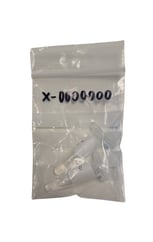 Ensure all tube caps are securely closed. Place the corresponding 'viral' and 'bacterial' tubes (sharing the same barcode) into a single zip-lock bag for shipment.
- Write the barcode of the tubes on the zip-lock bag.
- Store all bags containing the bacterial and viral tubes at room temperature (between 4°C and 25°C) until shipment.
- Samples are now stabilized and ready for shipment to PathoSense.
- Samples can be storaged for 1 month